
10 Ways to Use an AI Notetaker App in Your Daily Work
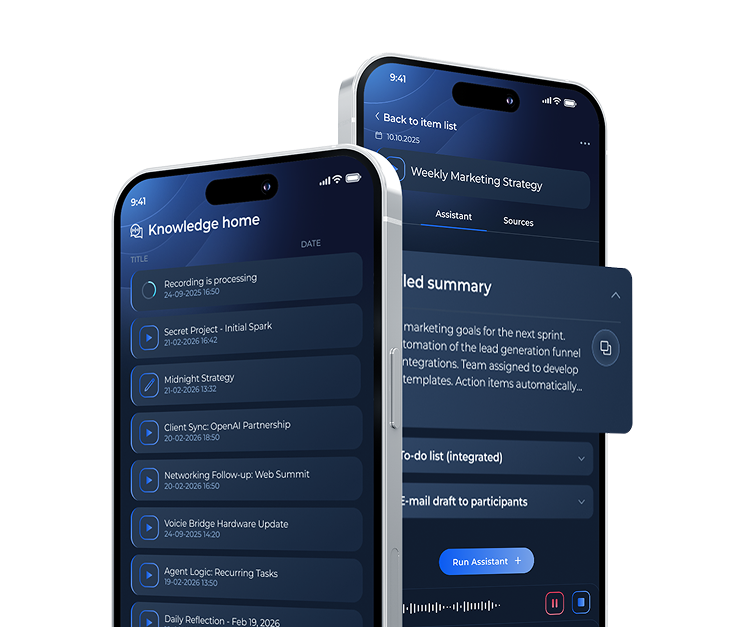
Voicie is an AI voice assistant for knowledge management. Below are 10 practical scenarios where users leverage Voicie to capture ideas, automate documentation, create content, and integrate with external tools. Voicie is a tool that adapts to your workflow. It doesn't impose a single way of working - it gives you building blocks to create your own system.
1. Capturing Ideas on the Go
You’re driving, listening to a podcast, and suddenly an idea hits you. You can’t type because you’re behind the wheel. In half an hour that idea will be gone — just like the previous twenty.
One click — and you record your thought. After getting home, you add the podcast link to the same knowledge item. You open the chat: “Based on the podcast and my thoughts, create LinkedIn post variations.” Moments later you have ready-made drafts. No idea gets lost.
2. Automatic Sales Call Documentation
You have several sales calls a day. After each one, you have to enter notes into the CRM — company name, needs, budget, next steps. 15-20 minutes per client. Every day. With 5 calls a day, that’s over an hour and a half of pure admin work.
With Voicie, that time drops to zero. You record the call, the assistant “Sales Call Analysis” extracts the key points and generates a JSON with the company name, budget, needs, and next steps. Via webhook, the data goes straight to HubSpot or Pipedrive. You focus on selling, the system handles documentation. End of day — the CRM is fully updated, and you haven’t written a single note by hand.
3. Creating Social Media Content
You have plenty of post ideas but lack the time to write and format them. Throughout the day, you record short voice notes — observations, thoughts, quotes. In the evening, you run an assistant with instructions tailored to your tone, which creates post variations with different hooks. You pick the best one and publish. Writer’s block? What writer’s block?
Speaking is more natural than writing — that’s why recorded voice often contains better phrasing than what you’d squeeze out of yourself staring at a blank document.
4. Team Meeting Summaries
Team meeting. Someone should be taking notes, but everyone would rather discuss.
On a MacBook, you create a new Knowledge Item and start recording. Voicie captures both your voice and system audio — your colleagues’ voices from Zoom, Google Meet or Teams. On your phone — one click and you record your side of the conversation.
After the meeting, the assistant creates a summary with a task list, the webhook sends the summary to Slack and creates tasks in ClickUp (via n8n or Make). A ready summary in 2 minutes after the call ends. Nobody has to take notes. Everyone has the same information. And if someone couldn’t attend the meeting — they get the full transcript and summary, instead of a vague “we talked about project X.”
5. Voice Journal — Daily Summary
Keeping a journal sounds great in theory. In practice — who has time to sit down every evening and write?
With Voicie, you don’t have to. Throughout the day, you record short notes — what happened, what insights you had, what you’re planning. In the evening, the “Daily Summary” assistant creates a report: what went well, key takeaways, priorities for tomorrow. You can also run weekly or monthly summaries. AI helps spot patterns you’d miss on your own.
6. Learning from Podcasts, Courses, and Webinars
You watched an hour-long webinar. How much do you remember the next day? 10%? 5%?
While watching, record your reflections in Voicie. Afterward, open the chat and ask for a summary, a “To Implement” list with specific things to apply, or key concepts in question-answer format. AI has the full context of the material and your notes, so the results cover what was actually discussed — not generic internet filler. Passive listening turns into active learning.
7. Preparing Personalized Proposals
You have a proposal template. After each client call, you manually fill it in — an hour of work. With three clients a week, that’s three hours of pure copy-pasting.
In Voicie, you have a knowledge item with templates and a client knowledge item with the call recording. You tell the chat: “Based on the call with client XYZ, create a proposal using the Standard template.” The assistant extracts data from the conversation — project scope, budget, deadline — fills in the template, and the finished document appears in the knowledge item. Minutes instead of hours. The proposal is personalized because AI draws from the real conversation, not generic filler.
8. Recruitment — Comparing Candidates
Fifth job interview this week. What did the first candidate say? Which one mentioned Python experience?
Each interview in Voicie is a separate source in the “Recruitment — Position X” knowledge item. The assistant extracts skills, strengths, and concerns for each candidate. Once you have them all, you ask in the chat: “Compare candidates based on experience and communication skills.” Decisions based on data, not impressions from the last interview.
9. Health and Fitness Tracking
After a workout you say: “Today 50 push-ups, 30 squats, 5 km run.” After a meal: “Scrambled eggs with avocado and whole wheat toast.” That’s it.
The “Health Coach” assistant analyzes calories and macros, and via webhook the data goes to Google Sheets. Every week you get a report — how much you trained, what you ate, what trends show up in the data. Tracking without typing anything manually.
10. Document Automation — Contracts, Emails, Reports
This scenario shows the full power of Voicie. You have a knowledge item with a framework contract template. You have a client knowledge item — with call recordings, correspondence, project specifications.
You tell the chat: “Based on the contract template and client information, create a ready contract with an attachment for the website.” AI takes the template, fills it with client data from recordings and notes — and generates a ready document. Minutes instead of hours.
What Other Use Cases Are There?
These 10 scenarios are just the beginning. Voicie can be used in thousands of ways — the only limit is your workflow and your imagination.
A few ideas that didn’t make the list: minutes from general assemblies, journalistic interview transcription, internal process documentation, preparing briefs for freelancers, keeping a project journal in a software house, recording feedback after usability tests. Each of these scenarios works on the same principle: you record your voice, build context, AI processes the data, a webhook sends the result where it needs to go.
The common thread? You speak — Voicie does the rest. You record your thoughts, build context, run AI, automate the data flow. No typing, no copying, no switching between dozens of apps.
If you want to see how fast transcription works on a MacBook — read Voicie Desktop on macOS with real-world timing results.
Frequently asked questions
Can Voicie transcribe Zoom meetings?
Yes. On macOS, Voicie records system audio from Zoom, Google Meet, Teams, and any other app. It captures both your microphone and the audio from your speakers, transcribing the full conversation. On your phone, you can record your side of the conversation.
How do I use Voicie for content creation?
Record voice notes throughout the day with your thoughts, observations, and ideas. Then run a “Content Creator” AI assistant that turns your raw notes into polished social media posts, articles, or emails. The assistant works from your actual voice — so the output sounds like you, not like generic AI.
Does Voicie work for recruitment?
Yes. Record each interview as a separate source in a “Recruitment — Position X” Knowledge Item. After all interviews, ask the AI chat to compare candidates by experience, skills, or communication style. Decisions based on data, not impressions from the last conversation.